
Twice last year, over Memorial Day and Labor Day weekends, I dove into the Mad Men marathon on the AMC Movies channel. It stills airs there, so I will catch episodes now and then. The show arrived on HBO Max earlier this year, coming back into our cultural conversation.
I came to Mad Men after finishing The Sopranos a decade ago. Matthew Weiner, the show runner, had joined The Sopranos in later seasons, hired after David Chase came across Weiner’s script for Mad Men’s pilot. It was Labor Day weekend 10 years ago when I watched the pilot, a few days before a big move. Tim Van Patten, another Sopranos alumn, directed the episode, shot by Phil Abraham, a Sopranos cinematographer, camera operator, and director.
Like with The Sopranos, it took me a few episodes to get into the show. For the former, it was “The Legend of Tennessee Moltisanti.” For Mad Men, the show’s third episode “Marriage of Figaro,” where Don leaves Sally’s birthday party. In both instances, I felt a moment of elevated interest after the foundation of a few episodes, where quiet momentum starts to unearth an artistic effect.
During these marathons, I jump in and out at various episodes and seasons, as the show moves in a continuous loop for the few days it airs. In season 1’s finale, Draper’s internal conflicts are on view as he pitches Kodak to name slides device “the carousel” instead of “the wheel”—a device for nostalgia, experiencing life through the eyes of a child. The carousel:
…lets us travel the way a child travels. Around and around andback home agarn. A place where we know we are loved.
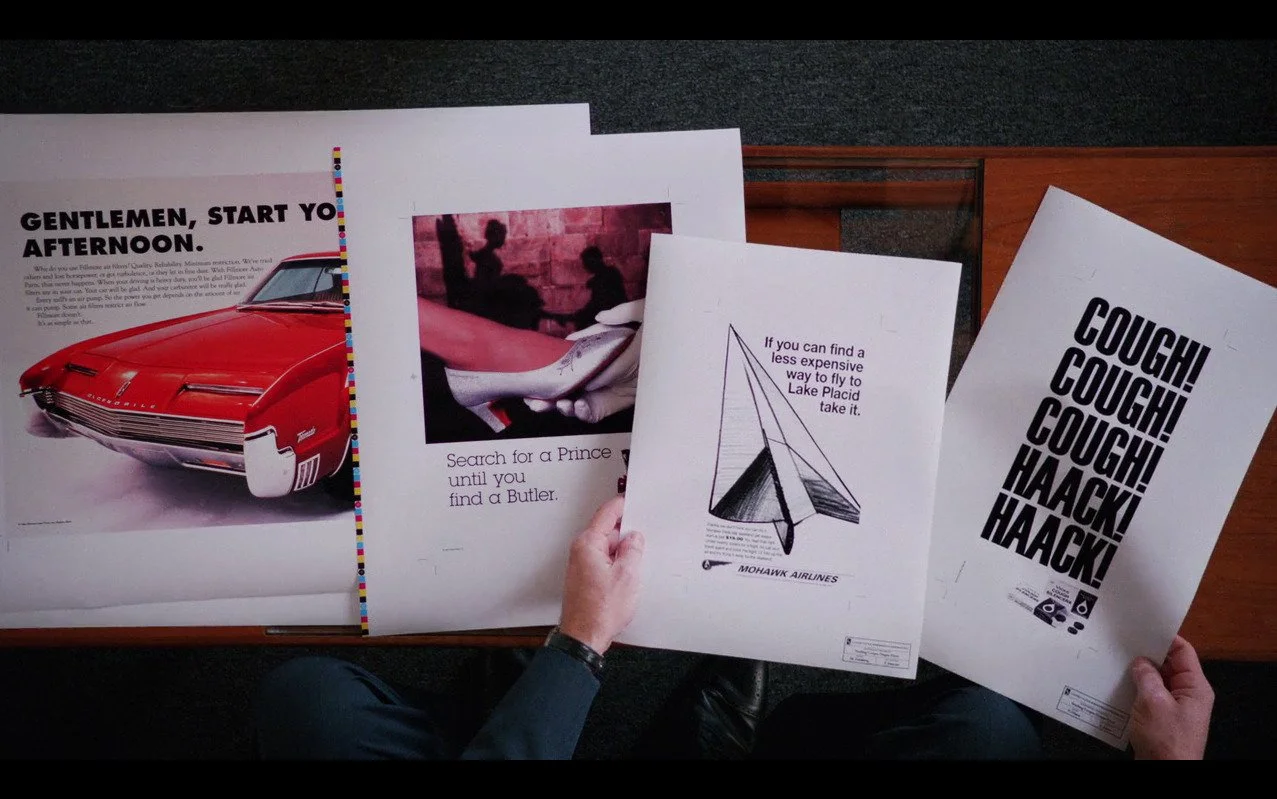
Mad Men screen grab.
Viewing the show in this manner has a similar effect. Mad Men creates a strong lens into the cultural developments of 1960’s America, but does it in a way that is subtle, centered on characters in context. The viewer feels the dynamics of the decade’s social and political atmosphere through the progression of plot and character, as well as through the way the news colors their lives—whether on the radio, newspaper, television, or in conversation. The 1960s was only 60 years ago, but to me it always felt far away. The outbreak of color television almost demarcates the birth of our modern age, an age that I was born into and feels perpetual. The 1940s and 1950s felt even further back to me, but were not that long ago. The show begins in 1960 and ends in late 1969.
An essay by Piers Briton, “Style, Structuring Conceits, and the Paratexts of Mad Men,” illustrates the show’s complex relationship to this decade.
Mad Men in toto is thus an encapsulation of the Sixties, a fact that is likely to be remembered long after its narrative twists, recapitulations, and volte faces have faded from the memory of all but the most devoted fans. The “Sixties-ness” of Mad Men is in part marked by historical events that variously affect the protagonists’ work, emotional life, and attitudes, from the 1960 presidential election to the 1970 Newsweek gender discrimination lawsuit. More obviously, and from certain vantage points more potently, Mad Men is defined by the 1960s in terms of visual style. Quite apart from offering a much publicized parade of vintage fashions, period props and stylish environments, the show visually evokes late Fifties and Sixties films in its cinematography, and especially its lighting.
This stylization is perhaps an irony. Is the show itself an ad for the very time its depicting? That intentionality would be up to a viewer to decide. Britton continues:
[I]f the show did not in any absolute sense espouse period authenticity it seems hard to overstate its Sixties-philiac tendencies. Visual pleasure in Sixties styling looms large, as a key part of Mad Men’s identity… Mad Men has reworked and mobilized the so-called “mid-century modern” to generate not just media buzz but an extraordinarily influential brand… like Don Draper it has always embodied—even depended on—a duality. Other film and television texts may have de facto thrived on a tension between the espousal of emotional truthfulness on one hand and preoccupation with “superficial” visual pleasures on the other, but Mad Menis perhaps the first in which this dichotomy has been so smoothly reconciled into a branding strategy.
This tension of Mad Men makes it fascinating, and its world, indeed its stylization, is what makes it immersive. As Don Draper explains in his pitch for “the carousel,”
Technology is a glittering lure, but there is the rare occasion when the public can be engaged in a level beyond flash. If they have a sentimental bond with the product. [A Greek copywriter] said the most important idea in advertising is “new.’ It creates an itch…[He] also talked about a deeper bond to a product. Nostalgia—it’s delicate, but potent. [He] told me that in Greek nostalgia means literally “the pain from an old wound.” It’s a twinge in your heart, far more powerful than memory alone.
A footnote in the aptly titled Mad Men Carousel reader (p. 206) by Matt Zoller Seitz points to two video essays to better understand the thematic world of Mad Men through craft and context. In “RETRO: The Camera & 'Mad Men,” Jefferson Robins discusses the cinematographic techniques that Phil Abraham established on the show and Christopher Manley continued, particularly the dolly work of push-ins and pull-outs. The latter move often has the camera settle on compositions marked by “doorframes, walls, [and] corridors” that engulf the characters. Mad Men’s filmmaking “gives the viewer room to breathe it all in and provides an almost subliminal emphasis.” Jim Emerson further expands upon this idea in the video “Modern Compartments: The Architecture of Mad Men” by highlighting the observational vantage points of an episode in season 4.
There are many potential reasons as to why Mad Men has found a new audience in the 2020s. Its elegant craft is surely a contributor, as the primary vessel for presenting the show’s themes and characters. The show then leaves the viewer to digest what they see, hear, and feel.
- GJF